Kefir and yogurt both turn fresh milk into something tangier and more complex through lactic acid fermentation, but the gap between kefir and yogurt is wider than most people realize. Kefir is fermented by a living ecosystem of bacteria and yeasts that can number 30 or more strains, while yogurt relies on just two bacterial species working in a simple partnership. That single difference cascades into fermentation temperature, texture, carbonation, and live-culture count.
What Kefir and Yogurt Have in Common
Both start with milk. Both use lactic acid bacteria to convert lactose into lactic acid. Both lower the pH enough to coagulate milk proteins into a tangy, thickened product. And both can deliver live, active cultures to your gut if they have not been heat-treated after fermentation.
In plain English, kefir and yogurt are cousins, not strangers. They share the same raw material and the same basic chemical trick: sugar becomes acid, acid thickens the milk, and the result is a more shelf-stable, more digestible food. If you want the deeper picture of which fermented foods actually survive your stomach acid, our breakdown of fermented foods for gut health covers the full survival test.
But the similarities end at the starter culture. The moment you ask what is actually doing the fermenting, kefir and yogurt part ways completely.
The Microbial Cast: Bacteria vs Yeast

Yogurt is a duet. Two bacteria, Streptococcus thermophilus and Lactobacillus delbrueckii subsp. bulgaricus, do essentially all the work. S. thermophilus goes first, acidifying the milk and lowering the pH. L. bulgaricus follows, producing more acid and the acetaldehyde that gives yogurt its characteristic flavor. In plain English, one bacterium softens the milk, the other finishes the job and adds the tangy aroma.
Some commercial yogurts add extra strains like Lacticaseibacillus rhamnosus, Lactobacillus acidophilus, or Bifidobacterium species for probiotic marketing. But the regulatory definition of yogurt in most countries requires those two core strains. As the Frontiers in Microbiology review of fermented foods notes, the “live and active” seal in the U.S. refers specifically to S. thermophilus and L. delbrueckii subsp. bulgaricus. If you want to go deeper on what those cultures actually do in your gut, our article on whether yogurt supports a healthy gut breaks it down strain by strain.
Kefir is a different beast entirely. It is fermented by kefir grains, which are not cereal grains at all but a living, self-replicating community of bacteria and yeast held together by a polysaccharide matrix called kefiran. Think of them less like a packet of powder and more like a tiny coral reef: a structured ecosystem in miniature. As we explain in our deep dive on what is actually inside kefir grains, the grain is a SCOBY, a Symbiotic Culture of Bacteria and Yeast.
The microbial roster inside a kefir grain includes lactic acid bacteria like Lactobacillus kefiranofaciens (the kefiran producer that builds the grain’s structure), Lacticaseibacillus paracasei, Lactiplantibacillus plantarum, Lactococcus lactis, and Leuconostoc mesenteroides. On the yeast side, you find Kluyveromyces marxianus and Kluyveromyces lactis (both ferment lactose), plus Saccharomyces cerevisiae and Kazachstania unispora. Some grains also harbor acetic acid bacteria like Acetobacter species.
Here is the huh-didn’t-know-that fact: up to 50 different bacterial and yeast species have been identified in artisanal kefir grains, with 30 or more strains commonly present in a single batch. Yogurt has two. That is not a small difference in diversity. It is the difference between a string quartet and a full orchestra playing the same piece.
| Feature | Kefir | Yogurt | What It Means in Practice |
|---|---|---|---|
| Starter culture | Kefir grains (SCOBY) | Powdered direct-set starter | Kefir grains are alive and self-replicating; yogurt starter is consumed each batch. |
| Microbial types | Lactic acid bacteria, yeasts, acetic acid bacteria | Lactic acid bacteria only | Yeasts add CO2, ethanol, and complex flavors that yogurt cannot produce. |
| Number of strains | Up to 50 species (commonly 30-plus) | 2 core strains (sometimes 4 to 6 with added probiotics) | Kefir is a full orchestra; yogurt is a duet. |
| Fermentation temperature | 20 to 25°C (room temperature) | 42 to 45°C (thermophilic) | Kefir ferments on the counter; yogurt needs a warm incubator. |
| Fermentation time | 18 to 28 hours | 6 to 8 hours | Kefir takes about 3 to 4 times longer. |
| Texture | Drinkable, thin, slightly effervescent | Thick, spoonable gel | Kefir is a beverage; yogurt is a food. |
| Carbonation | Yes, from yeast CO2 production | No | Kefir can fizz naturally; yogurt never does. |
| Typical CFU count | Up to 20 billion per serving | Around 6 billion per serving | Both deliver billions of live cells, but counts vary by brand and shelf life. |
How Fermentation Differs
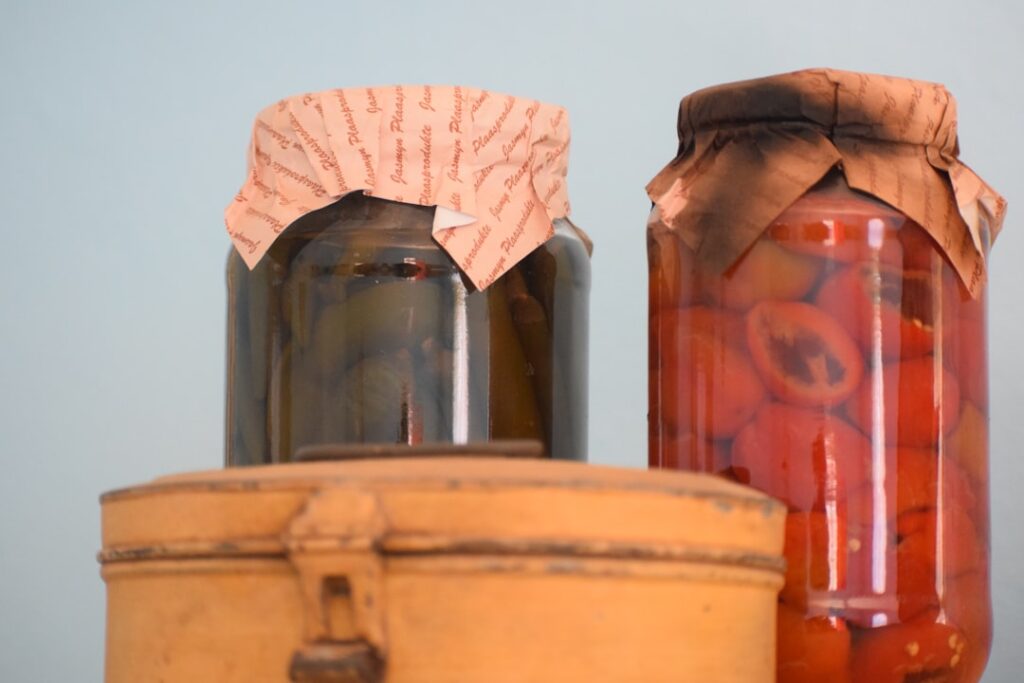
Yogurt ferments hot and fast. Kefir ferments cool and slow. The temperatures are not arbitrary. They reflect the fundamental biology of the organisms involved.
Yogurt’s two bacteria are thermophilic, meaning they grow best at elevated temperatures. The optimal range for S. thermophilus and L. delbrueckii subsp. bulgaricus is 40 to 45°C, with commercial production typically running at 42°C. At that temperature, fermentation completes in about 6 to 8 hours, reaching a final pH around 4.5. According to the Tetra Pak Dairy Processing Handbook, thermophilic cultures used for yogurt require 40 to 45°C for optimal growth, while mesophilic cultures used for other dairy ferments prefer 20 to 30°C.
Kefir’s microbial community includes mesophilic lactic acid bacteria and yeasts that prefer room temperature. Traditional kefir fermentation occurs at 20 to 25°C over 18 to 28 hours, with 24 hours being the most common duration. Research published in the journal Microorganisms confirms that traditional kefir is produced by inoculating milk with 2 to 10 percent kefir grains and fermenting statically for 18 to 28 hours at 20 to 25°C.
In plain English, yogurt needs a warm incubator. Kefir just needs your kitchen counter. And because kefir ferments at a lower temperature for a longer time, the microbial community has more opportunity to produce the secondary compounds that give kefir its complexity: ethanol, carbon dioxide, diacetyl (the molecule behind buttery aroma notes), and acetic acid.
The Symbiotic Loop Inside Kefir Grains
The mechanism that makes kefir possible is symbiosis. The lactic acid bacteria acidify the milk and produce the kefiran matrix that holds the grain together. The yeasts ferment lactose into ethanol and CO2, and they also produce B-group vitamins that stimulate bacterial growth. Each group feeds the other. In plain English, the bacteria build the house, and the yeasts keep the kitchen stocked.
You cannot recreate a kefir grain by mixing the individual strains in milk. The grain’s structure and stability emerge from centuries of co-evolution. That is why the grain is the culture, not just a container for it. Drop the grains in fresh milk and within 18 to 48 hours they have fermented it and added to their own mass.
Texture, Taste, and Live-Culture Count
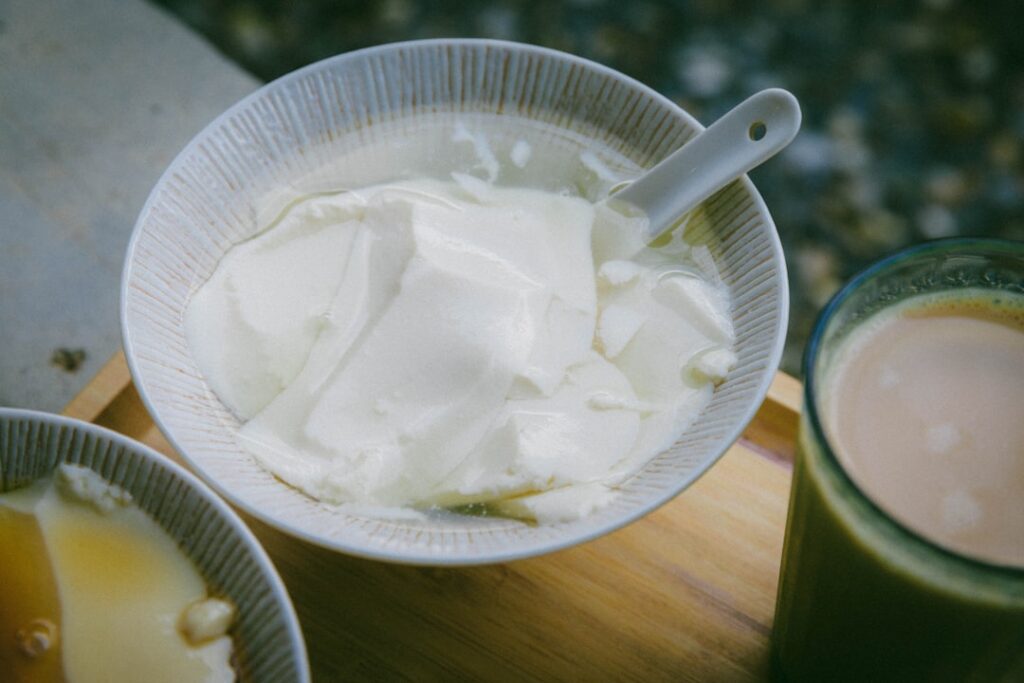
Yogurt is a gel. Kefir is a drink. The texture difference comes directly from the microbial mechanism.
In yogurt, lactic acid bacteria produce enough lactic acid to drop the pH to about 4.5, which is the isoelectric point of casein, the main milk protein. At that pH, casein proteins unfold and cross-link into a three-dimensional network that traps water and holds its shape on a spoon. The result is the thick, spoonable texture most people recognize as yogurt.
Kefir also coagulates casein, but the grain’s yeasts produce carbon dioxide, which creates tiny bubbles that break up the protein gel. The result is a thinner, drinkable consistency with a slight natural fizz. Some kefir can even pressure-seal a jar if left too long at room temperature. In plain English, the yeasts are literally blowing bubbles through the curd.
Flavor follows the same pattern. Yogurt’s taste is clean and tangy, driven mainly by lactic acid and acetaldehyde. Kefir is tangy too, but also slightly yeasty, slightly sour from acetic acid, and sometimes very mildly alcoholic, typically well under 1 percent ABV. The complexity comes from having multiple microbial metabolisms running in parallel instead of just one.
The Numbers: CFU Counts Compared
According to Colorado State University Extension, kefir can contain up to 50 live, active microbial species and over 20 billion colony-forming units (CFUs), while yogurt typically contains 1 to 5 species and around 6 billion CFUs. Research published in Frontiers in Microbiology found lactic acid bacteria counts in homemade kefir ranging from 5.32 to 9.60 log CFU per milliliter, with yeast counts from 2.49 to 7.80 log CFU per milliliter.
In plain English, a log CFU is scientific shorthand for bacterial population on a base-10 scale, so 8 log CFU per milliliter means roughly 100 million live cells per milliliter. Both kefir and yogurt deliver billions of live organisms per serving, but kefir typically delivers more, and with greater strain diversity.
Here is the practical caveat: CFU counts vary enormously by brand, batch, fermentation time, storage temperature, and whether the product was pasteurized after fermentation. The number on a label is a snapshot, not a guarantee. What matters more is whether the product is still alive when you eat it, and how many different strains are present. The Codex Alimentarius standard for kefir requires at least 7 log CFU per milliliter of lactic acid bacteria and at least 4 log CFU per milliliter of yeasts at the date of minimum durability. For yogurt, the U.S. FDA requires a minimum of 10 million CFU per gram (10^7) at the time of manufacture to carry a “live and active cultures” claim, and the International Dairy Foods Association’s voluntary seal requires 10 times that, at least 100 million CFU per gram.
So Which Should You Try?
If you want a thick, creamy, spoonable food with a clean tangy flavor and a well-studied evidence base for lactose digestion, yogurt is the simpler, more predictable choice. It is also the more versatile ingredient in cooking and baking.
If you want maximum microbial diversity, a more complex flavor profile, and a drinkable format that delivers a broader cast of live organisms, kefir is the clear winner. The trade-off is variability: homemade kefir with real grains can taste different every batch, and commercial kefirs vary widely in quality and strain count.
The honest answer is that they serve different purposes. Yogurt is a reliable workhorse. Kefir is a microbial adventure. If you are curious about the full landscape of fermented dairy, both belong in your rotation.
Send us the food question you cannot stop thinking about, and we will break down the mechanism behind it. Gastronomy Facts And Articles is always looking for the next ingredient claim, kitchen myth, or label promise worth testing against the actual chemistry.
Frequently Asked Questions
Is kefir just drinkable yogurt?
No. Kefir and yogurt use completely different starter cultures. Yogurt relies on two thermophilic bacteria, while kefir is fermented by kefir grains containing dozens of bacterial and yeast strains that produce a different flavor, texture, and microbial profile.
Which has more probiotics, kefir or yogurt?
Kefir generally contains more strains and higher CFU counts. Traditional kefir can harbor 30 or more microbial species with over 20 billion CFUs, while yogurt typically has 2 to 5 species and around 6 billion CFUs. Both counts vary widely by brand and batch.
Can you make yogurt from kefir grains?
No. Kefir grains produce kefir, not yogurt. The two products require different starter cultures with different organisms. You can make a yogurt-like product from kefir grains, but it will have the flavor, carbonation, and microbial profile of kefir, not yogurt.
Is kefir or yogurt better for lactose intolerance?
Both can help because their live cultures carry microbial lactase that breaks down lactose. Kefir may have a slight edge because its diverse microbial community, including lactose-fermenting yeasts like Kluyveromyces marxianus, breaks down more of the milk sugar during fermentation.
Does kefir contain alcohol?
Yes, but typically in trace amounts. The yeasts in kefir grains produce small amounts of ethanol as a byproduct of fermentation. Most homemade kefir contains well under 1 percent alcohol by volume, often closer to 0.5 percent or less.


0 Comments