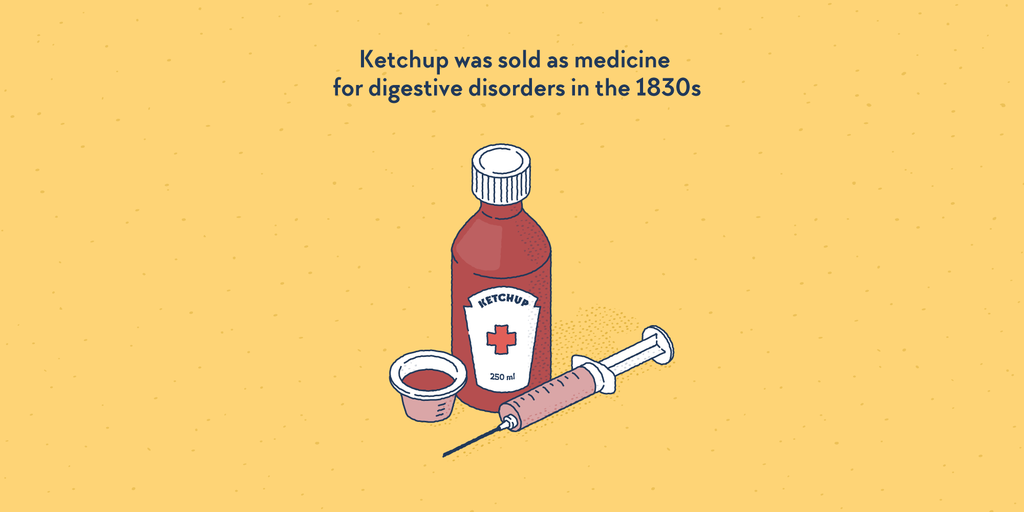
Grab a bottle of ketchup from the fridge today, and it’s hard to think of it as anything but a burger topping. But in the 1830s, Americans weren’t squeezing ketchup onto fries — they were swallowing it in pill form, on a doctor’s advice, to cure everything from indigestion to syphilis. For a brief, strange window in American history, ketchup wasn’t a condiment at all. It was medicine.
Tomatoes Had a Terrifying Reputation
To understand how ketchup ended up as medicine, you have to understand how Americans felt about tomatoes in the first place: they were scared of them. Tomatoes belong to the nightshade family, and many people believed they were poisonous. That fear was widespread enough that in 1820, a horticulturalist named Robert Gibbon Johnson reportedly ate an entire basket of tomatoes in public in Salem, New Jersey, just to prove they wouldn’t kill him.
Against that backdrop, an Ohio physician named John Cook Bennett made an unusual pitch in 1834. Bennett began publicly promoting tomatoes as a medical cure, arguing they could treat indigestion, jaundice, diarrhea, and other common ailments of the era. Given that cholera outbreaks and unregulated “cures” loaded with mercury and lead were common in the 1830s, a plant-based remedy that wouldn’t actively poison the patient had real appeal.
From Tonic to Pill
Bennett didn’t stop at recommending tomatoes — he turned them into a product. He worked with a pill manufacturer to distill his tomato ketchup recipe into concentrated pill form. They sold it under the name “Extract of Tomato.” The pills were marketed as a gentler, more natural alternative to the era’s harsh purgatives and dangerous chemical compounds.
The idea caught on fast. Newspapers ran glowing accounts of ketchup users finding relief from pain and stomach trouble. The tomato pill became a full-blown medical fad. It tapped into a broader public appetite for “natural” plant-based cures over synthetic ones.
The Great Tomato Pill Gold Rush
Success invited copycats — and that’s where things went sideways. Once Bennett’s tomato pills proved profitable, a wave of competing sellers flooded the market. Some pushed tomato-based remedies that claimed to cure conditions as serious as syphilis. Others claimed their pills could even heal broken bones. One widely advertised product, “Dr. Miles’ Compound Extract of Tomato,” turned out not to be made by a doctor at all. An Ohio merchant sold it, using the name purely as a marketing device.
As competition heated up, quality control collapsed. Independent tests on some of these tomato remedies found that certain products didn’t contain any actual tomato at all. Many turned out to be little more than repackaged laxatives sold under a trendier name.

The Fad Collapses
By the 1850s, the tomato pill craze had run its course. Physicians began publicly denouncing the products, ad campaigns cooled off, and the studies that did get conducted found no evidence to support the sweeping medical claims that had fueled the boom in the first place. The public simply lost interest, and what had briefly been a booming corner of the patent-medicine industry quietly folded.
That collapse didn’t kill off tomatoes or ketchup, though — it just stripped away the medical branding. People kept eating tomatoes anyway, folding them into soups, pies, jams, and sauces, because whatever their supposed healing powers turned out to be, they were still genuinely good to eat.
From Cure-All to Condiment
Ketchup’s shift from “medicine” to “condiment” wasn’t instant. Tomato-based ketchup recipes had actually existed even before the pill craze — Philadelphia scientist James Mease published one of the earliest known versions back in 1812. But it took Henry J. Heinz, decades later in 1876, to turn ketchup into the shelf-stable, mass-produced product we recognize today, using vinegar to solve the spoilage problems that had plagued earlier recipes.
Heinz didn’t just fix the formula — he also fixed the image, packaging his ketchup in clear glass bottles specifically to showcase the product’s purity at a time when food safety was becoming a real public concern. That rebrand, paired with early food-safety reforms, is what finally allowed ketchup to shed its medicinal past and become the everyday table sauce it is now.

Why This Story Still Resonates
The tomato pill craze is a pretty good snapshot of 19th-century America: a country hungry for miracle cures, largely unregulated, and quick to chase the next big health trend — sound familiar? It’s a reminder that “natural” and “healthy” claims aren’t new marketing tactics, and that skepticism toward unverified health products has always been useful.
So the next time you squeeze ketchup onto a plate of fries, you can appreciate it for what it actually is now — genuinely tasty — instead of what it briefly, bizarrely claimed to be: a cure for whatever ails you.
Have another food fact you want fact-checked and turned into a full post? Send it over and I’ll dig into the history behind it.



0 Comments